
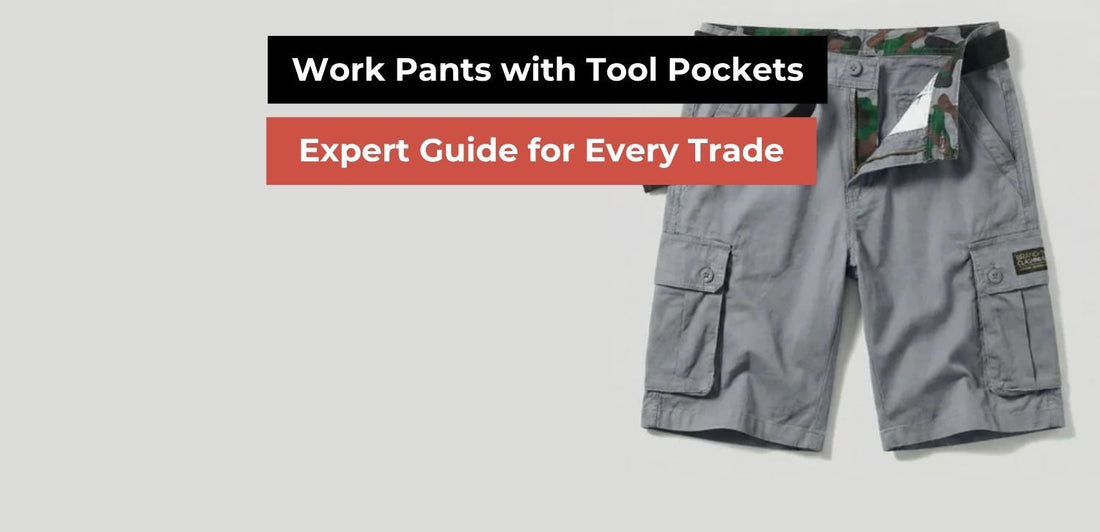

If you've ever watched a tape measure disappear into a shallow pocket mid-job, you already know the cost of bad workwear design. The right work pants with tool pockets eliminate that friction from day one. This guide breaks down exactly what to look for, by trade, by fabric, and by use case.
Short answer: The best work pants with tool pockets have deep thigh pockets you can reach while kneeling, reinforced or bar-tacked openings, closures suited to your work (zips at height, flaps for dust), knee pad pockets, a gusseted crotch and fabric that suits your conditions.
In this guide
What Makes a Tool Pocket Actually Useful?

Not all tool pockets are built equal. A pocket that looks functional on a hanger can fail completely on a job site. Here's what actually matters:
- Depth is non-negotiable. A thigh pocket needs to be deep enough to hold a utility knife or a tape measure without it bouncing out when you crouch.
- Position changes everything. Hip-level pockets work for lightweight items like pens or markers. Thigh-level pockets — set just above the knee — give you clean, unobstructed access whether you're standing, kneeling, or climbing a ladder.
- Closure type depends on your environment. Open-top pockets offer speed. Flap pockets protect against dust and debris on demolition sites. Zip pockets are essential when working at height — nothing leaves your pocket involuntarily.
- Reinforcement is what separates a pant that tears in months from one that lasts. Look for CORDURA®-lined pocket openings and bartack stitching at stress points. Without them, daily tool loading tears fabric fast.
These four criteria — depth, position, closure, reinforcement — are your baseline filter before looking at anything else.
Check out this guide too: Best Steel Toe Work Boots: Safety, Comfort and Protection Guide
Key Features Beyond the Pockets
The best work pants with tool pockets fail fast if the surrounding construction can't keep up. Pocket layout is only one piece of the equation. Here's what holds the whole garment together over months of daily abuse:
Fabric choice drives everything. Duck canvas (10–12 oz) is the gold standard for heavy trades — abrasion-resistant, structured, and built to outlast cheaper alternatives. Ripstop nylon is the right call for warm environments or high-mobility jobs: lighter, faster-drying, and surprisingly tough. CORDURA®/NYCO blends , widely used in military uniforms, offer the best of both worlds: cotton comfort with nylon durability.
Double-knee reinforcement is non-negotiable for floor workers. If your job puts you on your knees more than 2 hours a day — tile setters, plumbers, electricians running conduit — choose pants with either double-layered knees or knee-pad pockets. Standard single-layer fabric wears through in weeks under that kind of load.
Gusseted crotch + articulated knees = real mobility. These two construction details are the difference between pants that move with you and pants that fight you. A gusseted crotch eliminates seam stress when squatting. Articulated knees prevent that locked-up feeling when climbing ladders or stepping over obstacles.
DWR coating for mixed environments. A Durable Water Repellent finish won't replace waterproof outerwear, but it handles light rain, morning dew, and accidental spills without soaking through — a practical feature for anyone working outdoors part of the day.
What to look for by work conditions
- Heavy-duty trades: heavy-duty fabric, deep thigh tool pockets, reinforced hammer loops, and bartack stitching at every stress point.
- Warm conditions: four-way stretch, lightweight ripstop construction, and a thigh phone pocket positioned for crouched access.
- Cold and outdoor conditions: an insulated shell, sealed pocket openings, a DWR finish, and reinforced knees.
- Wet environments: fully waterproof construction with flap-sealed tool pockets.
How to Choose the Right Pair in 3 Questions
Before you buy, run through these three questions. They cut through the noise faster than any spec sheet:
- How often do you kneel or squat? More than 2 hours daily → double-knee reinforcement or knee-pad pockets are mandatory, not optional.
- What's your primary work environment? Outdoor, wet, or cold → prioritize DWR coating or waterproof construction. Indoor, heated, high-output → go lightweight and breathable first.
- How many tools do you carry at once? Five or more items → maximize pocket count. Fewer, heavier tools → prioritize pocket depth and reinforcement over quantity.
Check out this guide too: Good Working Boots for Men: What to Look For by Job
Tool Pocket Layouts by Trade
- Carpenters and framers: a reinforced hammer loop, deep thigh pockets for a tape and pencil, and knee pad pockets.
- Electricians: a slim thigh pocket for testers and screwdrivers, a phone pocket you can reach when crouched, and no metal hardware where it could be a hazard.
- Plumbers: knee pad pockets and flap pockets that keep debris out when you're under sinks or in crawl spaces.
- Warehouse and logistics: a few secure pockets for a scanner, knife and phone, in a lighter stretch fabric.
Socks Are Part of the Kit
Loaded pockets add weight that your feet carry all shift. MASON, the work sock brand, makes Tradesman Socks (8 in) and Tradesman Boot Socks (13 in) from 56% bamboo lyocell, 38% nylon and 6% spandex, with Cloud Cushioning under the heel and ball of the foot and an Arch Strap that stops the sock bunching.
Stop Losing Time to Bad Pockets
Every minute spent fishing for a misplaced tool is a minute you're not productive. The right work pants with tool pockets aren't a luxury — they're a direct investment in your daily output and long-term comfort on the job. Match your pocket layout to your trade, your fabric to your environment, and your construction details to your physical demands. The difference shows up within the first week on the job.
Pair your boots with cushioned work socks, like MASON work socks.
Frequently asked questions
What should I look for in work pants with tool pockets?
Are tool pockets better than a tool belt?
Want more workwear guides like this in your Google results? Add trymasonco.com as a preferred source.
Next, see cargo work trousers.
