

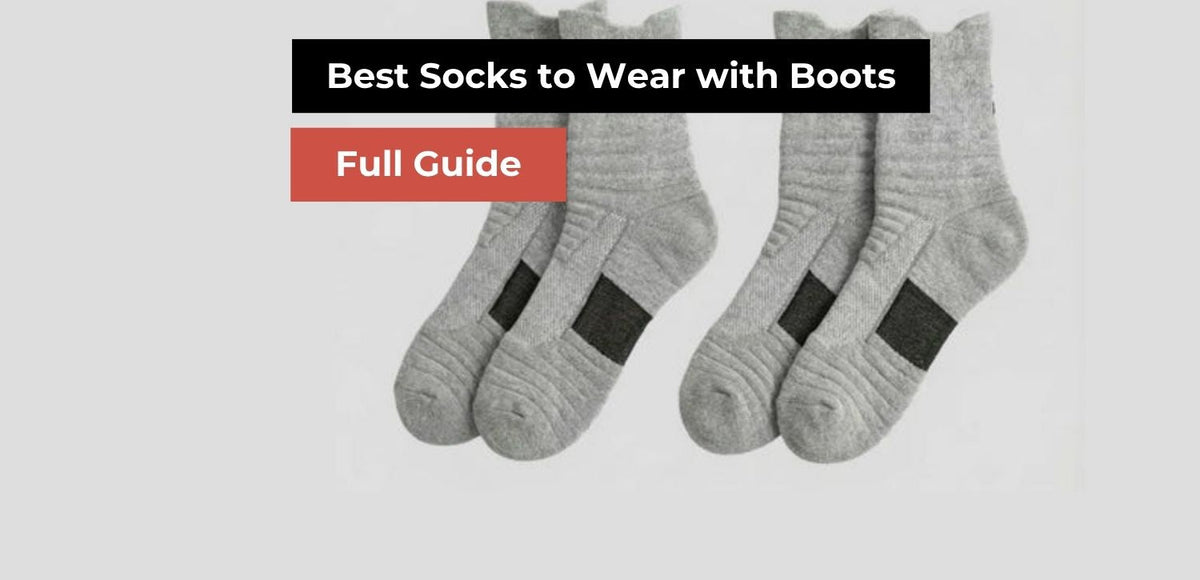
The best socks to wear with boots come up higher than the boot collar, fit snugly without bunching, and wick sweat instead of soaking it up. The sock height and thickness depend on the boot: a tall boot needs a tall sock, and a snug boot needs a thinner one.
Most people put real money into boots and then grab whatever socks are in the drawer. That shows up a few hours later as a rubbing heel, sweaty feet or cold toes. This guide matches the sock to the boot, for work boots and everyday boots alike.

In this guide
What socks should you wear with boots?
Wear socks that are taller than your boots, made from a moisture-wicking blend, with cushion at the heel and ball of the foot if you're on your feet all day. Cotton is the fiber to avoid for long days, because it holds sweat against the skin.
- Height: above the boot collar, so the boot never rubs bare skin.
- Fit: sized by your shoe size, so the heel pocket sits on your heel.
- Fiber: a bamboo, merino or synthetic blend with nylon, not cotton.
- Thickness: matched to how much room the boot has.
Which socks go with which boots?
Start with the boot. This table gives the quick match.
| Boot | Sock height | What to look for |
|---|---|---|
| Work boots (6 inch) | Crew | Cushion at the heel and ball of the foot |
| Tall work or hiking boots | Boot or over-the-calf | Clears the collar, firm cuff |
| Chelsea and dress boots | Thin crew | Smooth knit that doesn't crowd the boot |
| Cowboy and pull-on boots | Over-the-calf | Arch band so the sock doesn't slide |
| Winter and insulated boots | Boot height | Stays dry; thick only if the boot still fits |
| Rubber and wellington boots | Knee-high or boot | Covers the shin, wicks sweat |
Work boots
Work boots need the most from a sock: cushion for hard floors, reinforcement where the boot rubs, and a blend that handles a full shift of sweat. The guide to the best socks for work boots covers every work boot type, including steel toes.
Chelsea and dress boots
Chelsea and dress boots usually fit closer than work boots. A thin crew sock in a smooth knit keeps the fit right. A thick cushioned sock can make a snug boot press on the toes.
Cowboy and pull-on boots
Pull-on boots have no laces to hold the foot, and tall shafts rub the shin. An over-the-calf sock covers the shin, and an arch band keeps the sock from sliding down as you walk.
Hiking boots
Hiking boots need a sock that clears the collar and cushions the heel and forefoot for long distances. A wicking blend matters more than thickness on warm days.
Winter and insulated boots
In winter boots, dry beats thick. A wet sock chills the foot fast. A thicker sock adds warmth only if the boot still fits with it on; a squeezed foot loses circulation and gets colder.
What socks should you wear under boots to stop rubbing?
To stop boots rubbing, wear a sock that's taller than the boot, fits your shoe size, and stays put with an arch band and a firm cuff. Rubbing usually comes from a sock that slides down, folds under the arch or ends below the collar.
- Pick a sock sized by your shoe size, not one size fits all.
- Make sure the cuff sits above the top of the boot.
- Lace the boot so the heel doesn't lift.
- Change into a dry pair if your feet get soaked.
The guide to why socks slide down and bunch up in boots covers the causes in detail.
Thick or thin socks with boots?
Whether thick or thin socks work better depends on the boot fit: a roomy or insulated boot suits a thicker sock, while a snug boot needs a thinner one. Try boots on with the socks you'll actually wear in them. For cushion levels, see the guide to thick cushioned socks.
MASON socks to wear with boots

MASON, the work sock brand, makes Tradesman Socks (crew, 8 in) and Tradesman Boot Socks (boot, 13 in) from 56% bamboo lyocell, 38% nylon and 6% spandex, with Cloud Cushioning under the heel and ball of the foot and an Arch Strap that stops the sock bunching.
Here's which pair suits which boot:
- Tradesman Socks: crew height, for 6 inch work boots, ankle boots and safety shoes. Reinforced heel and toe.
- Tradesman Boot Socks: boot height, for tall lace-up, pull-on and winter boots. Flat-knit seamless toe for safety toe boots.
- Tradesman Heavyweight Socks: the heavier option in the range, for cold sites.
- Tradesman Wide Calf Boot Socks: boot height with more room at the calf.
You can compare every pair in the work socks for long shifts collection.
How to make boot socks last longer
Boot socks last longer when you rotate enough pairs and keep them away from high dryer heat. A pair worn every day without a full wash and dry wears out faster.
- Rotate at least five pairs for a five-day work week.
- Wash cold, inside out.
- Air dry or tumble dry low.
- Keep toenails trimmed so they don't wear through the toe.
Frequently asked questions
What socks do you wear with boots?
Should socks be higher than your boots?
What socks go with Chelsea boots?
Are wool socks good for boots?
Can you wear boots without socks?
Want more workwear guides like this in your Google results? Add trymasonco.com as a preferred source.
Next, see the guide to sock heights for boots.
